Monday, 24 November 2014

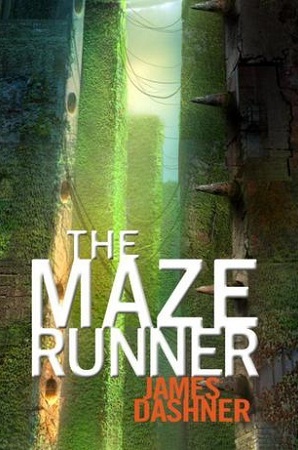
The Maze Runner


by James Dashner


"If you ain’t scared, you ain’t human.
When Thomas wakes up in the lift, the only thing he can remember is his name. He’s surrounded by strangers—boys whose memories are also gone.
Nice to meet ya, shank. Welcome to the Glade.
Outside the towering stone walls that surround the Glade is a limitless, ever-changing maze. It’s the only way out—and no one’s ever made it through alive.
Everything is going to change.
Then a girl arrives. The first girl ever. And the message she delivers is terrifying.
Remember. Survive. Run."


I also read this book last summer, in part because I wanted to know the story before watching the movie (official trailer following). In fact I have not seen the movie yet but I read the hole trilogy of books xD I just think the last book needed a final like Harry Potter, but I enjoyed it very much.


Tuesday, 18 November 2014

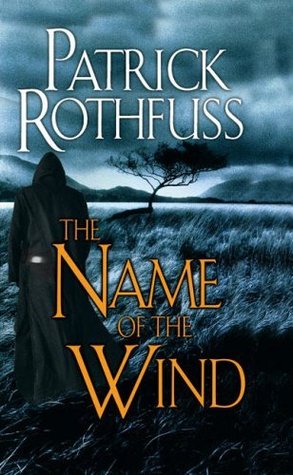
The Name of the Wind


by Patrick Rothfuss

"Told in Kvothe's own voice, this is the tale of the magically gifted young man who grows to be the most notorious wizard his world has ever seen. The intimate narrative of his childhood in a troupe of traveling players, his years spent as a near-feral orphan in a crime-ridden city, his daringly brazen yet successful bid to enter a legendary school of magic, and his life as a fugitive after the murder of a king form a gripping coming-of-age story unrivaled in recent literature. A high-action story written with a poet's hand, The Name of the Wind is a masterpiece that will transport readers into the body and mind of a wizard."

This is a book I read last summer and despite being really big (662 pages) it only took me 3 or 4 days to finish it. I really enjoyed the book, the main character (even if sometimes his actions are not the ones I wanted him to do), the world, the university....and so on.

Friday, 14 November 2014

IRB Barcelona


Scientists at Barcelona’s Institute for Research in Biomedicine have been busy learning their dance moves for this video to raise support for research into diseases such as cancer and metastasis, Alzheimer’s and diabetes.


The Institute for Research in Biomedicine (IRB Barcelona) has launched an innovative video ­– featuring its scientists as dancers. Departing from formats more traditional to research institutes, the YouTube video is a key element in a viral fundraising campaign aimed at raising awareness and support for IRB Barcelona and its activities as a world-class research centre devoted to understanding fundamental questions about human health and disease.

The video is accompanied by a three-pronged fundraising campaign that aims to help ensure that the video goes viral. For each viewing of the video on YouTube, IRB will receive a donation from its sponsors (*see full list below), who in addition to covering production costs of the video, have pledged contributions in direct support of IRB research. Donations can also be made by texting IRBBARCELONA to 28014 (in Spain only**), and via IRB Barcelona’s website (http://www.irbbarcelona.org/donate).

The hope is that the more exposure this video achieves, the more interest and support there will be for IRB’s critical work in biomedical research, from students and scientists from across the world, future sponsors, and society at large.

Tuesday, 11 November 2014

52 Of The Most Common Myths and Misconceptions Debunked In One Infographic


Did you know that black belts do not indicate ninja-level mastery, adding only a sprinkle of salt to fresh water does not make it boil quicker, and that sharks do get cancer? These are all part of the myths and misconceptions infographic created by London-based author, data-journalist and information designer David McCandless.

The chart is organized by colored topic (ie. orange for food and green for nature) and sized relative to its “virulence”—how many hits the question turns up on Google.


To see all eighty myths and misconceptions, check out the infographic mega-tome Knowledge is Beautiful by David McCandless.

Wednesday, 5 November 2014

The Chemistry of The Colours of Blood


These days I was surfing on the internet and found this interesting title and I immediately wanted to share with you :) This was prepared thinking on the Halloween thematic.


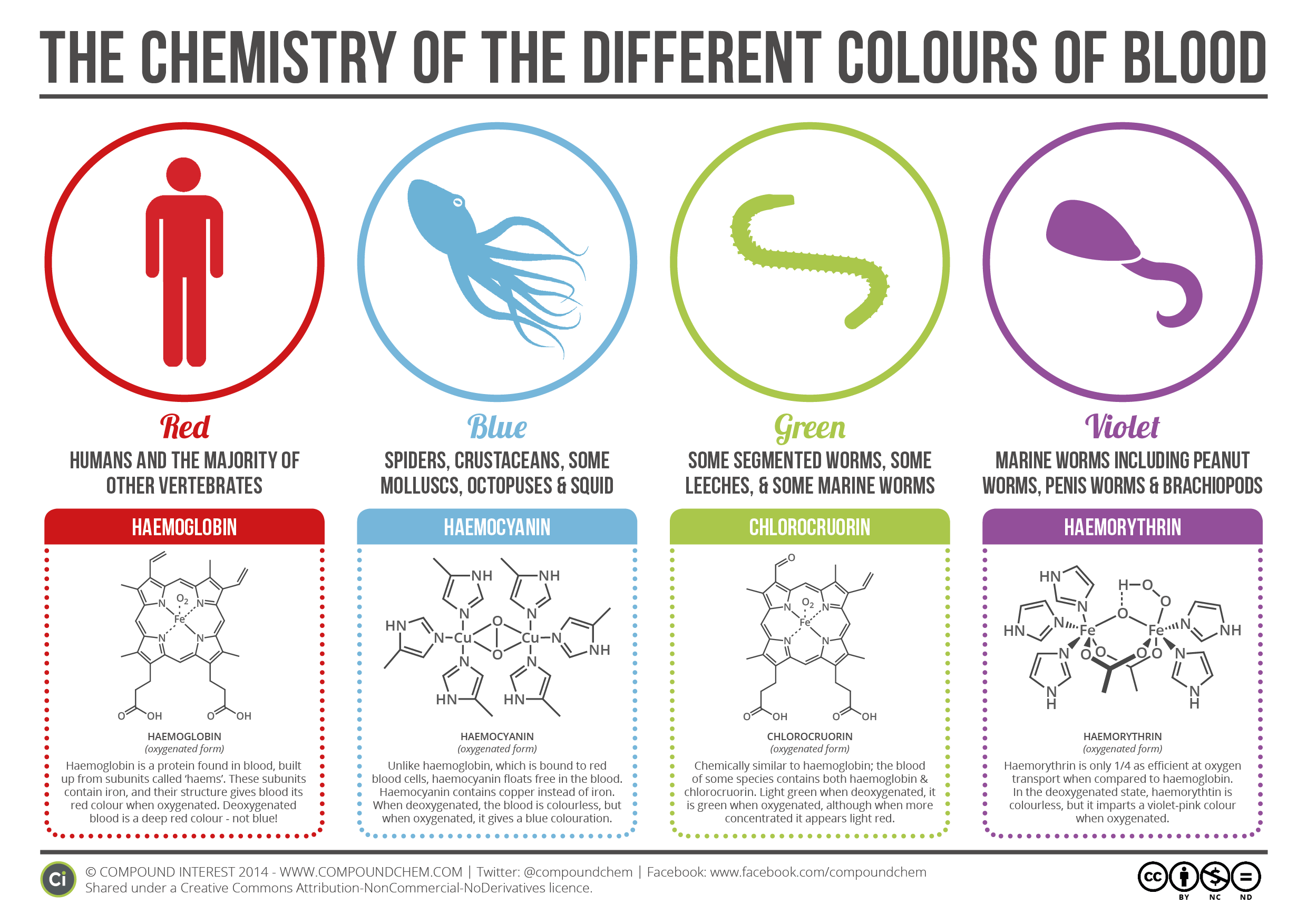
You probably already have a pretty good idea of the reasons behind the red colouration of human blood that fake blood mimics. However, red is not the only blood colour available – it also comes in blue, green, violet, and even colourless varieties – and this is a result of the specific chemicals that make up blood in different organisms.

So, let’s start with what we already know. Most people will have learnt that human blood, as well as that of most other vertebrates, is red as a result of haemoglobin, a large protein found in red blood cells which contains iron atoms within its structure. Haemoglobin is what’s known as a respiratory pigment, and it plays a vital role in the body, ferrying oxygen around the body to your cells and helping carbon dioxide back to the lungs where it can be exhaled. The large protein consists of four smaller units known individually as haems, each of which contains an iron atom. This can ‘bind’ to oxygen, giving red blood cells their oxygen transporting ability.


The iron atoms are also responsible for haemoglobin’s colour. The individual haems are conjugated molecules – they have lots of alternating double and single bonds between carbon atoms in their structure – and this conjugation causes them to absorb light wavelengths in the visible portion of the spectrum, leading to a coloured appearance. The presence of the iron atom modifies this absorption slightly, and as such haemoglobin is a red colour when oxygenated, and a slightly darker red when deoxygenated.
It’s a commonly believed myth that deoxygenated blood is blue – after all, if you look through your skin at any of your veins, which carry deoxygenated blood away from your body’s cells, they have a definite blue-grey hue. However, this appearance is in fact caused by the interaction of light with both the blood and the skin and tissue covering the veins. There’s a detailed look at the slightly more complex reasons why veins appear blue, despite being red, in this paper examining the question.


There are some creatures, however, for whom blue blood is the norm. Crustaceans, spiders, squid, octopuses, and some molluscs all have blue blood as a result of having a different respiratory pigment. Rather than haemoglobin, these creatures use a protein called haemocyanin to transport oxygen. The differing structure of the pigment, as well as the incorporation of copper atoms instead of iron, leads to the blood being colourless when deoxygenated, and blue when oxygenated. They also bind to oxygen in a different manner to haemoglobin, with two copper atoms binding to each oxygen molecule.
It doesn’t stop there; green blood, too, is possible, in some species of worms and leeches. This is an interesting one, in that the individual units of chlorocruorin, the protein leading to a green blood colouration, are actually very similar in appearance to haemoglobin. In fact, they’re near identical – the only different is an aldehyde group in the place of a vinyl group in the chemical structure (although the name might suggest otherwise, chlorocruorin doesn’t contain any chlorine atoms).


Despite this minor difference, a noticeable colour change is the result – deoxygenated blood containing chlorocruorin is a light green colour, and a slightly darker green when oxygenated. Oddly, in concentrated solutions, it takes on a light red colour. A number of organisms that have chlorocruorin in their blood also have haemoglobin present as well, resulting in an overall red colouration.


Chlorocruorin isn’t always necessary for green blood, however, as the green-blooded skink lizard illustrates. This lizard is found in New Guinea, and despite its blood containing haemoglobin like other vertebrates, its blood is a distinctive green colour. The colour is due to a difference in how they recycle haemoglobin. Humans recycle haemoglobin in the liver, by breaking it down first into biliverdin, and then bilirubin. The lizards, however, aren’t capable of breaking down biliverdin any further, so it accumulates in their blood, giving a green colour intense enough to overpower the red colour of haemoglobin.
Finally, violet blood is also possible, albeit in a limited range of marine worms (including the rather unfortunately named penis worms). This colour is caused by yet another different respiratory pigment, this time one called haemorythrin. Haemorythrin contains individual units which themselves contain iron atoms; when deoxygenated, the blood is colourless, but when oxygenated it is a bright violet-pink. Like most of the other respiratory pigments, it’s a lot less efficient than haemoglobin, in some cases only having around a quarter of the oxygen carrying capacity.


What’s perhaps most interesting about the varying colours of blood is that it showcases evolution coming up with different solutions to the same problem – in this case, transporting oxygen. It’s funny to think that, if our blood incorporated copper-containing respiration pigments instead of iron, we might all be slapping on a different colour fake blood instead of red!

Wednesday, 29 October 2014

PORTO - the magic city

World famous for its production of fine port wine, the busy city of Porto sprawls along the hills overlooking the Douro River in northern Portugal.


I have to say that I live near Porto and the city is really amazing and romantic :p

Major Attractions in Porto:
-Igreja de Sao Francisco – Gothic church with a plain facade but tons of gold-leaf gilding inside. There is also a museum and catacombs below, which we found more fascinating than many guidebooks did.
-Ponte de D. Luis, the city’s emblematic iron bridge, built by a disciple of the famous Eiffel.

One of Europe’s finest bookstores, an architectural wonder, is located in Porto. Livraria Lello has been selling books since 1881.If you like to eat surrounded by books, you’ll need to try Book, a new restaurant at Rua de Aviz 10 serving nouveau Portuguese cuisine in a candlelit and bookish literary environment.
•Climb up to the Mosteiro da Serra do Pilar, from where you will gain an even more splendid view of the bend in the river, the bridge and the city.
•The Ponte de Dom Luis I -walk across the high upper deck if you dare for good views of Porto with Vila Nova de Gaia on the opposite bank.


Vila Nova de Gaia, is an across-the-river southern suburb of Porto perched on the steep banks of the Douro where Port wine lodges dominate the landscape. There are over 50 port producers within the narrow lanes where the wines are aged and blended. Tours and tasting is a must for a visitor with a taste for Port wine.At the heart of Porto is the charming pedestrian zone, the Ribeira, an atmospheric place on the river, buzzing in live music, cafes, restaurants.

Dominating this popular tourist setting is the Ponte Dom Luis, a metal, double-deck arch bridge that links Porto to Vila Nova de Gaia, well-known for its port wine cellars.

Porto, or Oporto, is Portugal’s second largest city and capital of Portugal’s beguiling north.
Porto was selected the 2001 European Capital of Culture which bestowed upon the city money for lots of cultural improvements.

Portugal, by virtue of its position on Europe’s Western edge, gets fewer travelers than other Mediterranean destinations.
But intrepid visitors are rewarded with uncrowded cities and moderate tariffs for food and hotels.

This is a place where you can splurge on a stay at a fine manor house and live in luxury for around 100 Euros a night.
Known mainly for its trade in Port wine, which travels along the east-west trending Douro river that starts in Spain, Porto has for its long history been known as a cosmopolitan trading center.


It still has blue collar working class feel, but it’s a sort of Vasco de Gama working class with a timeless style. You’ll see an array of architectural gems from Roman, Gothic, Baroque, Neoclassic and Renaissance eras in this scenic city built into the granite cliffs at the mouth of the river Douro.

Porto – Best Time To Go
Blossoming of almond, apples, pears, cherries, oranges and figs is particularly striking in February.
Summer is pleasant, with maritime winds moderating the climate. But expect some rain in summer.
For historic climate charts and current weather, see Porto Travel Weather.
12th century Cathedral or Se. Huge cathedral founded in the 12th century but extensively altered in the 18th. Open from 9am to 12:30 and 2:30 to 7pm.
Don’t miss the Ribeira do Porto, the cluster of buildings, smoky bars and seafood restaurants along the waterfront.

Designed by Xavier Esteves, it’s facade is neo-gothic, and the curving red stairway between levels, decorated walls and ceilings, and stained-glass skylight will amaze you.
Where to go for Great Views of Porto
•From the top of the Clerigos Tower, a 75 meter tower accessed with 225 steps.


For more information visit this website: http://www.portugal7days.com/
Good trips!


Sunday, 27 July 2014

Nasir al-Molk Mosque


Nasir al-Molk Mosque

When Sunlight Hits this Mosque, It is Just BreathtakingThe Nasir al-Molk Mosque in Iran, also known as the ‘pink Mosque’, is one of the most colorful on earth. The entire building is flooded with color when sunlight hits in. The use of stained glass, which is not common, creates this color spectacle. However, these photos look like they are from a fairytale story.


I hope you like it ;)